no sabes lo que es tener que andar así: Walter Olmos can be seen as one of the outliers of my taste in music. I am not from Argentina and have altogether spent not more than a month in that country spread out over several occasions. Yet it is my impression that Olmos is considered as being from the bottom of society and of the musical hierarchy. Olmos’ untimely death at the age of 20 from a gunshot self-inflicted in a round of Russian roulette (apparently he was sure the gun was jammed and in a macabre joke pulled the trigger at various friends and finally at himself upon which the weapon fired, killing him instantly) bears witness to a lifestyle that must have been destructive – Olmos himself on an occasion voiced his fear that he was going to die young as he was burning too fast (not the exact expression he used but something to that effect; I also hear that he took cocaine and was under the effect of it when he killed himself).
My Paraguayan host brother Raúl never got tired of telling me that Walter Olmos’ music was incredibly bad and he could not stop wondering why I would listen to something so trashy. So when I say that Walter Olmos is an outlier of my musical taste, I mean that I may just be the only person in the world who mostly listens Bach’s organ works but at the same time admits to liking Walter Olmos. I may also be the only person who listens to Walter Olmos but not his godfather in music, the cuarteto legend Rodrigo who died in a car crash not much earlier than Olmos, but more on that in the following.
I came across three of Olmos’ songs thanks to a CD that my brother brought in 2001 from a stay in Argentina which contained popular songs from that era. I also bought an original record of Olmos’ “A Pura Sangre” (most of my Paraguayan friends could hardly believe original CDs by Olmos and much less people who bought them even existed) – since my brother’s CD didn’t contain any Rodrigo songs, I just never got interested in him in the same way, as I do not connect any special memories to Rodrigo songs and I am not a systematic cuarteto listener.
The problem is evident from just a fleeting listen to Olmos’ album: Indeed, people rightly seem to suggest that Olmos’ music is incredibly bad because almost all of the songs undeniably sound the same, one of the hallmarks of incredibly bad music (cumbia act Ráfaga constitutes a similar case). Despite this, I think that if somebody knew only one song by Walter Olmos, or for that matter Ráfaga, they would think that this is quite amazing and lively music with nice chord progressions and a captivating rhythm. Therefore, let’s pretend for the present purposes that Olmos made no other songs except this one, Amor de Adolescentes, Adicto a ti and La Mano de Dios, and also that he premiered these songs rather than ripping them off from Rodrigo.
All things said, this song is great and I believe Olmos’ best in an unsurpassable version. I have heard the original by La Mona Jiménez as well as Rodrigo’s version, but I think Olmos owns this one and I never get tired of the melodrama and despair in his particular version of the song.
In my arrangement the violin plays the part of the both the synthesizer/keyboard in the beginning, as well as the accordion part throughout the main part of the song. I cannot deny that this arrangement was a venture into unknown territory – I am hardly familiar with any of the instruments played in a cuarteto ensemble, particularly the rhythm section: the congas and timbaletas. So I could not transcribe these things in much detail, but in any case my brother who is playing the drums in the video wouldn’t have been able to recreate it on his crappy drum kit anyway.
Apart from this my arrangement is very straightforward: The cello plays the bass part (one octave higher) and the guitar which does not appear in the original reinforces the cuarteto rhythmical pattern in the offbeat accents.
Walter Olmos may have been ignorant and may not have taken the best life choices, but his talent as a performer and his professionalism on stage are worth admiring.
para darse cuenta, te digo, no hay que ser muy pillo: Bersuit Vergarabat always has been and will continue to be one of my top five favourite rock bands. It is their strong lyrics writing, their members’ level of musicianship which allows them to transit effortlessly between the musical idioms of all manner of musical styles, and this incredible fusion of musical styles itself, to name only a few of the things that I admire about them, which are at the root of my ongoing fascination with this band.
Bersuit Vergarabat are so far the only band that I was eager enough to see live to actually travel to another country (Madrid, 2008) for a chance to see them. But the story started much earlier.
I first heard a Bersuit song when my older brother returned from an exchange year to Argentina in 2001 and brought back a CD with songs by various artists that were popular in Argentina at that time. Next to Los Abuelos de la Nada, Ráfaga, Walter Olmos and others it also contained the song La Bolsa by ersuit; we all listened to the CD for the whole summer vacation and La Bolsa soon became a favourite.
When I went to Paraguay in 2003 “De La Cabeza” was one of the first albums I bought, right at the beginning during a half-day stopover in Buenos Aires, and from there things took its natural course… Amazed by their range of styles, by the diverseness that is undoubtedly the result of having a band with eight members all of whom take part in the songwriting process and make their own contributions to it, and especially by the many traditional rhythms they incorporate in their music and which were unlike anything I’d ever heard before, I became a Bersuitero, soon bought all of their albums, including the first three which I only managed to find on a trip to Argentina, and I was a first-hand witness to the publication of “La Argentinidad al Palo” (about which I even wrote an essay at university which I hope to share at some later point). Finally a band which was at their peak just as I started liking it!
To this day I consider the album “Hijos del Culo” as Bersuit’s finest work and this song continues to hold a special place; therefore when I suggested this as one of the songs to play in our little concert for my mother’s 60th birthday, the response from my siblings was unanimous.
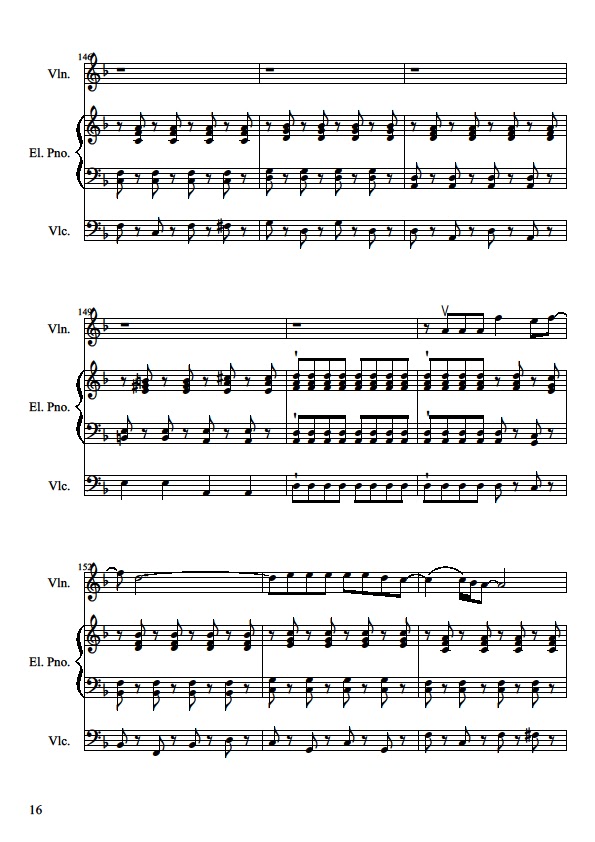
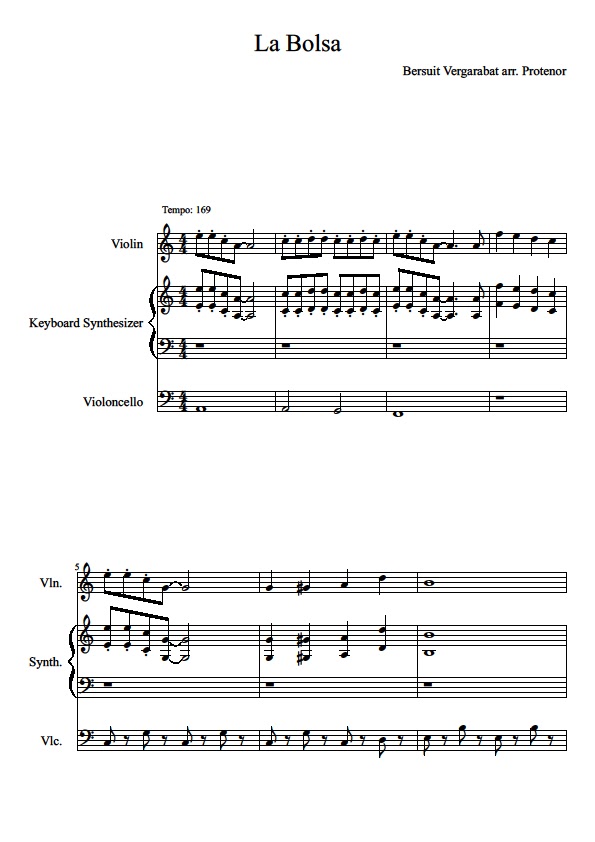
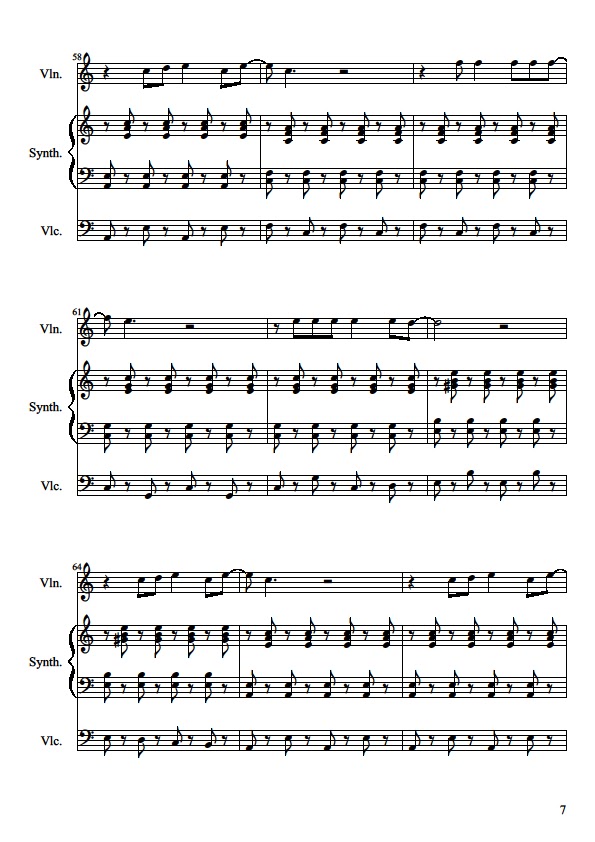
In arranging the song for the instruments we had – keyboards, drums, violin, violoncello and guitar – I was faced with several challenges. A true bass instrument was lacking, the rhythm section was thin, the violin part would have to be newly created, and a solution would have to be found for the second voice and the second guitar.
Finally, in my arrangement the violin plays the second voice wherever it appears; where there is none the violin plays some of the licks played by the second guitar, and during the intro, solo etc. it doubles the melody of the accordion (the part of which has been played on a keyboard, as Bersuit themselves do in live recitals). Accordingly, the guitar plays the offbeat chord pattern during the parts where the violin is playing the licks in the second guitar; when the violin plays the second voice, however, the guitar plays these licks, since the offbeat chord pattern (in typical cuarteto style) is also present in the keyboard accompaniment.
What observations can be made after understanding the musical skeleton of La Bolsa? It is a cuarteto piece with a distinct rock feel. As in a lot of the best songs, the backbone of the song is simple – a four chord progression (Am – F – C – E) which is repeated throughout the piece, albeit with constant variations. There are a lot of really nice harmonies between the two voices, and great solos by the accordion and the guitar at the end. The main melody from the intro is the greatest recognition factor however.
There is not much to be said about the lyrics – I am by now convinced that they are about a tour Bersuit did with “La Mona Jiménez” and one of the members of that band stealing Bersuit’s cocaine bag – we’ve all been there. I love how the lyrics periodically stray from this topic with sentences that are not easily understandable in the context of this interpretation, but which create a colloquial register causing an eagerness in the listener to understand what the story that is obviously being told, is about. Fuertes aplausos!
…si te quedan agallas: Ricardo Arjona… I have been listening to his music for ten odd years, own six of his albums, saw him live once, and even wrote an essay about him in one of my postgraduate courses. Yet, I have to admit that I have a unique love-hate relationship with his music. At times I have been taken aback at how unbelievably abysmal some of his songs are: Recycled melodies and rhymes that were already cheesy the first time he used them (no more luz/blues, please!) and some extremely awkward arrangements where the music seems composed around the most pedestrian poetry.
But I am not here to bash him. Because, on the other hand, he keeps surprising me with things all kinds of amazing; amazing poetry, amazing melodies and themes, texts that seem easily accessible and only when you look closer you discover there is a different layer of meaning… in short, music that touches something inside and which as a musician you can learn an immense lot from.
Santo Pecado is in my opinion Ricardo Arjona’s best album. One reason is that there is no really weak song on it, no song that seems like a rehash of earlier ideas. To the contrary there are some superb tracks, including but not limited to No sirve de nada, La nena, Mujer de lujo and the present track. But maybe most important are the arrangements; as I understand it Ricardo Arjona writes his song on the guitar, or maybe sometimes the piano, so what he ends up with are his lyrics and the sung melody, plus a harmonic skeleton and maybe sometimes a riff. I don’t know in how far it is him who decided that Mujer de lujo was going to be a tango, for example. It doesn’t really matter either. My point is that on this album it fits together perfectly; the genre of a song with its theme, in other words, the musical realization of a song’s content. So many of the songs on this album are really good tracks that could stand alone even with much weaker lyrics. A problem on some of the albums is one of musical economy: While Arjona has of course all the resources he could wish for, to me it seems ridiculous to have a whole string section on a song when all they do is add a cheesy flourish here and there. Such a sumptuous ensemble is only justified when it adds something fundamental to the song in terms of mood or harmony; otherwise it constitutes a poor aesthetical/artistic choice, like a dish with little nutrients and way too much MSG. Santo Pecado features great musical economy.
The present song is representative of the album’s balanced sound: I count the constituents of a classic rock band (acoustic guitar, bass, drums) plus a string section consisting of around one violin, viola and violoncello each, some backing vocals and an occasional synthesizer chord. The song features a classic structure of two verses, pre-chorus, chorus, verse, pre-chorus, chorus and a musically different bridge leading to a short acoustic outro that is usually omitted in live performances. Yet, throughout the repeated parts – the verses, pre-chorus and chorus – there are some subtle changes in the musical texture, creating contrasts and keeping the piece musically interesting. The most obvious example is beginning of the second verse (“Como duele gastar…”) in which only the string section accompanies, but also the second pre-chorus (“El ministerio del tiempo…”) during which the string section rests. Two more things related to the musical realization deserve mention: First, before I transcribed this song I had never realized that the characteristic guitar chord arpeggio that opens the song is actually maintained in some form throughout the whole song, making it a plausible musical representation of the minutes that keep ticking away; except, that is, during the beginning of the second verse which creates a sense of pausing for a moment that coincides with the meaning of the lyrics (“How painful it is to spend the moment in which you are no longer there, what a drain it is to struggle with the things that don’t come back…”). The second thing is Vinnie Colaiuta’s superb drumming that deserves a mention of its own – as on the whole rest of the album his excellent choices of grooves, accents and his awesome fills add something substantial to the songs as a whole; just listen to the part “Minutos pasajeros de un tren…” and you will know what I mean.
I had never really paid particular attention to this song’s lyrics, but as I listened to it again and again while I transcribed, I must say I was moved. The ambivalence of time… who has not wanted the time to pass slower at times and faster at others? Yet, no matter what you do, how you spend your time, the minutes keep ticking away… mercilessly. Once again, if you make an effort to look beyond the sometimes slightly silly expressions you will find that the song is telling a rather moving story that almost anyone can relate at some level. Lyrics-wise, again, I want to turn the attention to specific parts: The part “… si te quedan agallas” (“It’s already 7:16/ and the corpse of the minute that just passed/ tells me your strategy has ruined you/ so there is no choice, but to live alone/… if you have agallas left”). I remember asking my Paraguayan host brother Raúl what “agallas” meant and after short consideration he answered that it meant the same as “ganas” (something like “desire/wish/feeling like doing something”). The Real Academia on the other hand defines it as “Arrestos, valentía, audacia.” (“determination, courage, audacity”) which is close enough to what Raúl suggested, and which I had already intuited. Yet, my point is that I have always loved the illogicality of the phrase: If you have no choice, then why do you need determination? Is it the option to live alone that requires determination? But since there is no other option, why? Or does the option to live alone require courage, so as not to kill yourself? I am not really looking for an answer though – in a way the text is perfectly logical, through its illogicality: “You have no choice but to live alone, and good luck with it” is the slightly harsh meaning I get out of it.
Finally the last part of the song’s lyrics – the bridge: “Minutes that make fun of me/minutes like the fury of the sea/minutes, passengers on a train that is not going anywhere/minutes like a rain of salt/minutes like fire on the skin/minutes, strangers that come and go without letting you know/minutes that hurt when spent without you/minutes that don’t pay rent/minutes which upon dying form the battalion of yesterday/minutes that steal the light away/minutes the corrode my faith/minutes that inhabit the time for as long as they may last/minutes that enjoy dying/minutes that have no place/minutes that crash into me… they are God’s own kamikazes.” Just in case you were wondering why I like Arjona’s music so much.
а ну-ка наколдуй мне: Forget all your superheroes – Anton Gorodetsky kicks their ass! If you have watched the European version of the Russian movie “Night Watch” you have unfortunately missed out on this amazing track which effectively summarizes the plot of the movie. Which is quite an achievement on the part of the band - I mean how many hip hop songs do you know that tell the plot of an entire movie? But I am getting ahead of myself.
I remember the day my father brought this album (V Gorode N) home after getting it from one of his students. When this song came on, I was at first extremely amused by the opening: The first lines seemed so awkward and disconnected from the rest, seemed so much like Russian hip hop trying to emulate other models that I couldn’t fight feeling it was slightly ridiculous. It felt as though I had just gotten into the groove of the song when it skipped onto something completely else, never to get back to the beginning again. Yet, my amusement soon gave way to awe, as the song went on and I realized how amazing hip hop in Russian sounded, especially this song with its falling speech melody at the end of each line (as I realize now, similar to Mexican rock/hip hop band Molotov’s song “Here We Kum”). I have long admired hip hop for its word craftsmanship and its awesome beats which tend to hit you directly into the oldest part of the brain. Yet I could never really warm up to most hip hop lyrics, for their sexism as one obvious reason, but also for the need to put down your competitors/opponents as something which is directly opposed to the ethos of punk music in which everyone can be a musician as long as he means it. Still I could not stop pondering the potential that hip hop held for really saying a lot in case an artist had a lot to say. Rage Against The Machine is certainly one band which realized hip hop’s potential in that sense, but this is not bad at all either. Umaturman’s mix of musical styles is truly admirable, and despite this being their only hip hop song as far as I know, it does not mean it lacks quality in any sense.
I did not know anything about the resourcefulness of these lyrics when I first heard the song since I understood exactly zero of it. By now they have been explained to me since, and I feel that the potential of hip hop lyrics has been realized in a way that satisfies my sense of musical economy: Telling an entire story – in this case the plot of a movie – appears as putting the lyrical potential of a hip hop song to good use.
Umaturman went on to enjoy a special place in my listening habits, particularly as the soundtrack of countless vacation car rides with my father. It’s hard to get tired of accomplished pop music so diverse and lovingly created – you have ballads, up-tempo tracks, reggae, Latin rhythms… you name it(, we got it). Still in all of it there is a sense of Russianness, if there can be such a thing. It is hard to pinpoint, but there seems to be some very abstract quality in the melodies which has written Russian all over it (just as I get the notion of something typically Japanese in the music of Japanese bands as diverse as The Alfee and Koji Kurumatani). Of course pop music was not invented in Russia, and neither was hip hop. Therefore if Russian artists appropriate these genres, they had better add something of their own, lest their music become derivative and cheesy like a cheap rip-off. However, there is a thin line between adding something of your own, and becoming a parody of yourself in your emphasis of your “own-ness”. We don’t want a Russian band that tries very hard to be Russian and in trying so hard ends up reinforcing clichés and becoming a parody of their own Russianness (for example if they started including balalaikas in their songs which would be the cheesiest way a rock band could emphasize Russianness). Fortunately, Umaturman don’t have to try hard. They seem to just write music that they like which they might think sounds similar to the models it is based on, but which for some reason turns out Russian. I suspect that it is the situation of living some place in Russia which as any other place has its unique soundscape – songs on the radio, music traditions etc. – for all their lives that determines the band’s musical grammar and logic, and at some point in the creation of music adds that certain unmistakable flavour.
Why do I like the Russianness in Umaturman’s music? It is no secret that Russia is getting a bad rap in Western media these days. Since I lack the necessary unbiased information, I am in no position to comment on politics in any way, but I am certainly in a position to say that I would never extend any possible political strife to the country, Russian people, and Russian culture. I have never been to Russia, but I suspect that as in any other country there would be friendly people, and some that I would not like at all, and if I lived there long enough I would become close to some people, have good and bad experiences, learn the language (better), and fall in love. I have met Russians outside of Russia, not least in my own house on a number of occasions, and my experiences have by and large been favorable. So listening to music with something Russian about it adds to the variety in life and widens the horizon. Mother Russia, do not suffer, I know you’re bold enough; I’ve been around the world and I have seen your love.
다시 한 번 말하겠지마는: I was first introduced to this song on an afternoon in Wonju during the early rainy season of 2010 by my then-girlfriend who called it an example of Korean indie rock. She outlined the lyrics’ content and pointed out that the “hand dance” in the video was amazing since the movements represented exactly what was happening in the lyrics. The consensus among most Koreans seems to be that Chang Kiha’s song writing is remarkable for its use of the Korean language. When I recognized the song coming out of a store in Seoul a few weeks later, the Korean friend I was with commented that Chang Kiha in his songs “spoke like a book”. Two years later when I discussed the band with my Korean tutor in England on the occasion of the band’s visit to London, he too called Chang Kiha a genius, pointing out that whereas most K-pop bands used Korean in a way that rather unnaturally made it sound like English, Chang Kiha had succeeded in adapting the idiosyncrasies of the Korean language to rock/pop music which seems to be something that even Koreans who are not particularly fond of the band give them credit for. I am not familiar enough with prior Korean rock or K-pop, or well-versed enough in the Korean language to assess the novelty of Chang Kiha’s writing. What I can tell is that his lyrics are extremely close to spoken-style Korean as opposed to written Korean, and frequently feature a vocabulary that tends towards the colloquial; for a number of the words I looked up, I realized I knew alternative Korean words which were the ones that are taught in language class. This is not to say that the vocabulary is eclectic or contrived, but just that Korean language frequently has a number of words meaning the same thing, and that Chang Kiha uses words which may be seen as not being the standard vocabulary, much like you would in a casual conversation. Some examples are ŏjŏkke, manyang and ttan te. This as well as the number of idioms used in the chorus and other places endows the song with a very Korean flavour that is almost impossible to capture in translation.
What I can comment more on is the music. All in all it can be best described with the words of a Chinese classmate upon seeing the lunch menu in the university cafeteria a couple of days ago (the lunch was a Korean take on Western food, including yoghurt, corn soup, bread with butter and jam, French fries and spaghetti, for those times when you need an extra generous helping of carbs): shingihan chohap (a wondrous combination). This song is a most shingihan chohap indeed: You have the somewhat cheesy, hurdy-gurdyish main keyboard figure with its folksy bass accompaniment, the main charm arising from the displacement of the three-beat figure in the keyboard against the four-beat meter across the space of two bars each. Then you have the abrupt breaks, the verse with its funky bass and the strange pick scrape sounds on the guitar, the unexpected shift from b flat minor to g minor (relative key to the parallel key b flat major) for the threatening and dramatic chromatics in the pre-chorus (James Bond theme says hi), and finally the return to cheesyness with the call and response in the chorus and the awkwardness of the spoken lyrics between the repetitions, growing ever more chaotic and increasing in rhythmic complexity as bass and drums add accents of their own. But maybe the shinghan chohap is the postmodern songwriter’s device of choice as he creates something like a musical collage and makes use of everything that is available to him. If we measure the quality of music with the question of how well it achieves to be what it is trying to be, this is certainly a very accomplished song in bringing something unlikely and refreshing to the table of the South Korean musical scene. Chang Kiha’s biggest achievement may then be in what he is trying to achieve – after listening to more of their music and also interviews with him, I believe he has a very authentic and interesting musical vision and the necessary confidence that sets him apart from those who are insecure in what they should be trying to be and end up being no more than derivative and generic.
This is probably the most difficult song arrangement I have made, mostly because of the verse and my determination to adapt the pick scrapes into a descending chromatic figure – since there is not much else going on in the instruments during the verses, omitting the pick scrapes is unfortunately not an option and I could not think of an easier way to adapt them to piano either. Despite creating some additional exercises and practising those parts Hanon-style for months, it has been a challenge to get a halfway decent take without major mistakes throughout the whole of the song (I don’t edit my videos). I am even more self-conscious knowing that whenever Koreans do anything in front of an audience, they will usually have perfected it. Yet there was a point when I felt I had to get this one out and move on to something else. Goes to show that all Europeans can do is copy Asians.