…si te quedan agallas: Ricardo Arjona… I have been listening to his music for ten odd years, own six of his albums, saw him live once, and even wrote an essay about him in one of my postgraduate courses. Yet, I have to admit that I have a unique love-hate relationship with his music. At times I have been taken aback at how unbelievably abysmal some of his songs are: Recycled melodies and rhymes that were already cheesy the first time he used them (no more luz/blues, please!) and some extremely awkward arrangements where the music seems composed around the most pedestrian poetry.
But I am not here to bash him. Because, on the other hand, he keeps surprising me with things all kinds of amazing; amazing poetry, amazing melodies and themes, texts that seem easily accessible and only when you look closer you discover there is a different layer of meaning… in short, music that touches something inside and which as a musician you can learn an immense lot from.
Santo Pecado is in my opinion Ricardo Arjona’s best album. One reason is that there is no really weak song on it, no song that seems like a rehash of earlier ideas. To the contrary there are some superb tracks, including but not limited to No sirve de nada, La nena, Mujer de lujo and the present track. But maybe most important are the arrangements; as I understand it Ricardo Arjona writes his song on the guitar, or maybe sometimes the piano, so what he ends up with are his lyrics and the sung melody, plus a harmonic skeleton and maybe sometimes a riff. I don’t know in how far it is him who decided that Mujer de lujo was going to be a tango, for example. It doesn’t really matter either. My point is that on this album it fits together perfectly; the genre of a song with its theme, in other words, the musical realization of a song’s content. So many of the songs on this album are really good tracks that could stand alone even with much weaker lyrics. A problem on some of the albums is one of musical economy: While Arjona has of course all the resources he could wish for, to me it seems ridiculous to have a whole string section on a song when all they do is add a cheesy flourish here and there. Such a sumptuous ensemble is only justified when it adds something fundamental to the song in terms of mood or harmony; otherwise it constitutes a poor aesthetical/artistic choice, like a dish with little nutrients and way too much MSG. Santo Pecado features great musical economy.
The present song is representative of the album’s balanced sound: I count the constituents of a classic rock band (acoustic guitar, bass, drums) plus a string section consisting of around one violin, viola and violoncello each, some backing vocals and an occasional synthesizer chord. The song features a classic structure of two verses, pre-chorus, chorus, verse, pre-chorus, chorus and a musically different bridge leading to a short acoustic outro that is usually omitted in live performances. Yet, throughout the repeated parts – the verses, pre-chorus and chorus – there are some subtle changes in the musical texture, creating contrasts and keeping the piece musically interesting. The most obvious example is beginning of the second verse (“Como duele gastar…”) in which only the string section accompanies, but also the second pre-chorus (“El ministerio del tiempo…”) during which the string section rests. Two more things related to the musical realization deserve mention: First, before I transcribed this song I had never realized that the characteristic guitar chord arpeggio that opens the song is actually maintained in some form throughout the whole song, making it a plausible musical representation of the minutes that keep ticking away; except, that is, during the beginning of the second verse which creates a sense of pausing for a moment that coincides with the meaning of the lyrics (“How painful it is to spend the moment in which you are no longer there, what a drain it is to struggle with the things that don’t come back…”). The second thing is Vinnie Colaiuta’s superb drumming that deserves a mention of its own – as on the whole rest of the album his excellent choices of grooves, accents and his awesome fills add something substantial to the songs as a whole; just listen to the part “Minutos pasajeros de un tren…” and you will know what I mean.
My piano arrangement is rather self-evident in almost every possible sense, so I will limit myself to just a few comments – it seemed quite difficult to me at first, especially the big leaps in the right hand during the chorus, as well as a few other things, but with some practise it was quite manageable. In the verses I have tried to incorporate some of the drum accents in the left hand, as well as the most noticeable drums fills before the beginning of the second verse and the one mentioned above – it may seem a bit silly, but I liked it that way. During the pre-choruses (“La casa no es otra cosa.../El ministerio del tiempo...”) the bassline in my arrangement runs an octave higher than in the original – at first I just practiced it wrong, but when I noticed my mistake, I realized that it sounded better, stripping away some density to create a greater contrast with the chorus, so I continued to play it like that. I am especially proud of the arrangement of the bridge (“Minutos como lluvia de sal…”) – at first it seemed impossible to play, but even though it may not have turned out 100% smooth in my recording, it was great fun to play, and seems like one of my more successful arrangements to me. This brings me to the next and last point – the lyrics.
I had never really paid particular attention to this song’s lyrics, but as I listened to it again and again while I transcribed, I must say I was moved. The ambivalence of time… who has not wanted the time to pass slower at times and faster at others? Yet, no matter what you do, how you spend your time, the minutes keep ticking away… mercilessly. Once again, if you make an effort to look beyond the sometimes slightly silly expressions you will find that the song is telling a rather moving story that almost anyone can relate at some level. Lyrics-wise, again, I want to turn the attention to specific parts: The part “… si te quedan agallas” (“It’s already 7:16/ and the corpse of the minute that just passed/ tells me your strategy has ruined you/ so there is no choice, but to live alone/… if you have agallas left”). I remember asking my Paraguayan host brother Raúl what “agallas” meant and after short consideration he answered that it meant the same as “ganas” (something like “desire/wish/feeling like doing something”). The Real Academia on the other hand defines it as “Arrestos, valentía, audacia.” (“determination, courage, audacity”) which is close enough to what Raúl suggested, and which I had already intuited. Yet, my point is that I have always loved the illogicality of the phrase: If you have no choice, then why do you need determination? Is it the option to live alone that requires determination? But since there is no other option, why? Or does the option to live alone require courage, so as not to kill yourself? I am not really looking for an answer though – in a way the text is perfectly logical, through its illogicality: “You have no choice but to live alone, and good luck with it” is the slightly harsh meaning I get out of it.
Finally the last part of the song’s lyrics – the bridge: “Minutes that make fun of me/minutes like the fury of the sea/minutes, passengers on a train that is not going anywhere/minutes like a rain of salt/minutes like fire on the skin/minutes, strangers that come and go without letting you know/minutes that hurt when spent without you/minutes that don’t pay rent/minutes which upon dying form the battalion of yesterday/minutes that steal the light away/minutes that corrode my faith/minutes that inhabit the time for as long as they may last/minutes that enjoy dying/minutes that have no place/minutes that crash into me… they are God’s own kamikazes.” Just in case you were wondering why I like Arjona’s music so much.
no sabes lo que es tener que andar así: Walter Olmos can be seen as one of the outliers of my taste in music. I am not from Argentina and have altogether spent not more than a month in that country spread out over several occasions. Yet it is my impression that Olmos is considered as being from the bottom of society and of the musical hierarchy. Olmos’ untimely death at the age of 20 from a gunshot self-inflicted in a round of Russian roulette (apparently he was sure the gun was jammed and in a macabre joke pulled the trigger at various friends and finally at himself upon which the weapon fired, killing him instantly) bears witness to a lifestyle that must have been destructive – Olmos himself on an occasion voiced his fear that he was going to die young as he was burning too fast (not the exact expression he used but something to that effect; I also hear that he took cocaine and was under the effect of it when he killed himself).
My Paraguayan host brother Raúl never got tired of telling me that Walter Olmos’ music was incredibly bad and he could not stop wondering why I would listen to something so trashy. So when I say that Walter Olmos is an outlier of my musical taste, I mean that I may just be the only person in the world who mostly listens Bach’s organ works but at the same time admits to liking Walter Olmos. I may also be the only person who listens to Walter Olmos but not his godfather in music, the cuarteto legend Rodrigo who died in a car crash not much earlier than Olmos, but more on that in the following.
I came across three of Olmos’ songs thanks to a CD that my brother brought in 2001 from a stay in Argentina which contained popular songs from that era. I also bought an original record of Olmos’ “A Pura Sangre” (most of my Paraguayan friends could hardly believe original CDs by Olmos and much less people who bought them even existed) – since my brother’s CD didn’t contain any Rodrigo songs, I just never got interested in him in the same way, as I do not connect any special memories to Rodrigo songs and I am not a systematic cuarteto listener.
The problem is evident from just a fleeting listen to Olmos’ album: Indeed, people rightly seem to suggest that Olmos’ music is incredibly bad because almost all of the songs undeniably sound the same, one of the hallmarks of incredibly bad music (cumbia act Ráfaga constitutes a similar case). Despite this, I think that if somebody knew only one song by Walter Olmos, or for that matter Ráfaga, they would think that this is quite amazing and lively music with nice chord progressions and a captivating rhythm. Therefore, let’s pretend for the present purposes that Olmos made no other songs except this one, Amor de Adolescentes, Adicto a ti and La Mano de Dios, and also that he premiered these songs rather than ripping them off from Rodrigo.
All things said, this song is great and I believe Olmos’ best in an unsurpassable version. I have heard the original by La Mona Jiménez as well as Rodrigo’s version, but I think Olmos owns this one and I never get tired of the melodrama and despair in his particular version of the song.
In my arrangement the violin plays the part of the both the synthesizer/keyboard in the beginning, as well as the accordion part throughout the main part of the song. I cannot deny that this arrangement was a venture into unknown territory – I am hardly familiar with any of the instruments played in a cuarteto ensemble, particularly the rhythm section: the congas and timbaletas. So I could not transcribe these things in much detail, but in any case my brother who is playing the drums in the video wouldn’t have been able to recreate it on his crappy drum kit anyway.
Apart from this my arrangement is very straightforward: The cello plays the bass part (one octave higher) and the guitar which does not appear in the original reinforces the cuarteto rhythmical pattern in the offbeat accents.
Walter Olmos may have been ignorant and may not have taken the best life choices, but his talent as a performer and his professionalism on stage are worth admiring.
para darse cuenta, te digo, no hay que ser muy pillo: Bersuit Vergarabat always has been and will continue to be one of my top five favourite rock bands. It is their strong lyrics writing, their members’ level of musicianship which allows them to transit effortlessly between the musical idioms of all manner of musical styles, and this incredible fusion of musical styles itself, to name only a few of the things that I admire about them, which are at the root of my ongoing fascination with this band.
Bersuit Vergarabat are so far the only band that I was eager enough to see live to actually travel to another country (Madrid, 2008) for a chance to see them. But the story started much earlier.
I first heard a Bersuit song when my older brother returned from an exchange year to Argentina in 2001 and brought back a CD with songs by various artists that were popular in Argentina at that time. Next to Los Abuelos de la Nada, Ráfaga, Walter Olmos and others it also contained the song La Bolsa by ersuit; we all listened to the CD for the whole summer vacation and La Bolsa soon became a favourite.
When I went to Paraguay in 2003 “De La Cabeza” was one of the first albums I bought, right at the beginning during a half-day stopover in Buenos Aires, and from there things took its natural course… Amazed by their range of styles, by the diverseness that is undoubtedly the result of having a band with eight members all of whom take part in the songwriting process and make their own contributions to it, and especially by the many traditional rhythms they incorporate in their music and which were unlike anything I’d ever heard before, I became a Bersuitero, soon bought all of their albums, including the first three which I only managed to find on a trip to Argentina, and I was a first-hand witness to the publication of “La Argentinidad al Palo” (about which I even wrote an essay at university which I hope to share at some later point). Finally a band which was at their peak just as I started liking it!
To this day I consider the album “Hijos del Culo” as Bersuit’s finest work and this song continues to hold a special place; therefore when I suggested this as one of the songs to play in our little concert for my mother’s 60th birthday, the response from my siblings was unanimous.
In arranging the song for the instruments we had – keyboards, drums, violin, violoncello and guitar – I was faced with several challenges. A true bass instrument was lacking, the rhythm section was thin, the violin part would have to be newly created, and a solution would have to be found for the second voice and the second guitar.
Finally, in my arrangement the violin plays the second voice wherever it appears; where there is none the violin plays some of the licks played by the second guitar, and during the intro, solo etc. it doubles the melody of the accordion (the part of which has been played on a keyboard, as Bersuit themselves do in live recitals). Accordingly, the guitar plays the offbeat chord pattern during the parts where the violin is playing the licks in the second guitar; when the violin plays the second voice, however, the guitar plays these licks, since the offbeat chord pattern (in typical cuarteto style) is also present in the keyboard accompaniment.
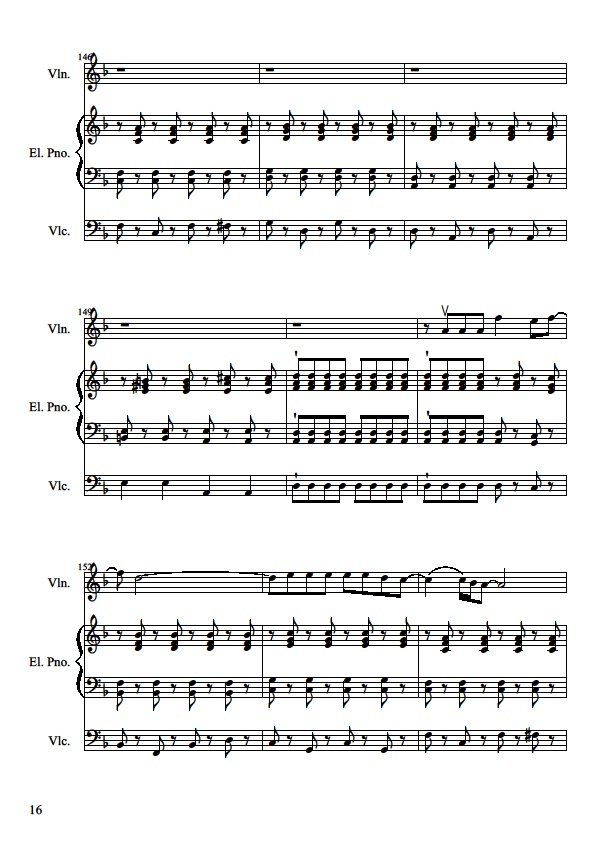
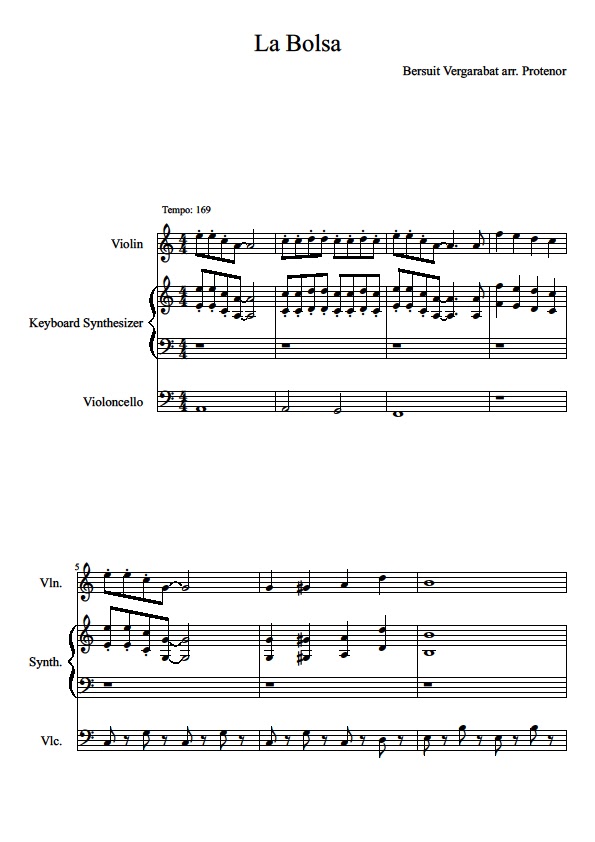
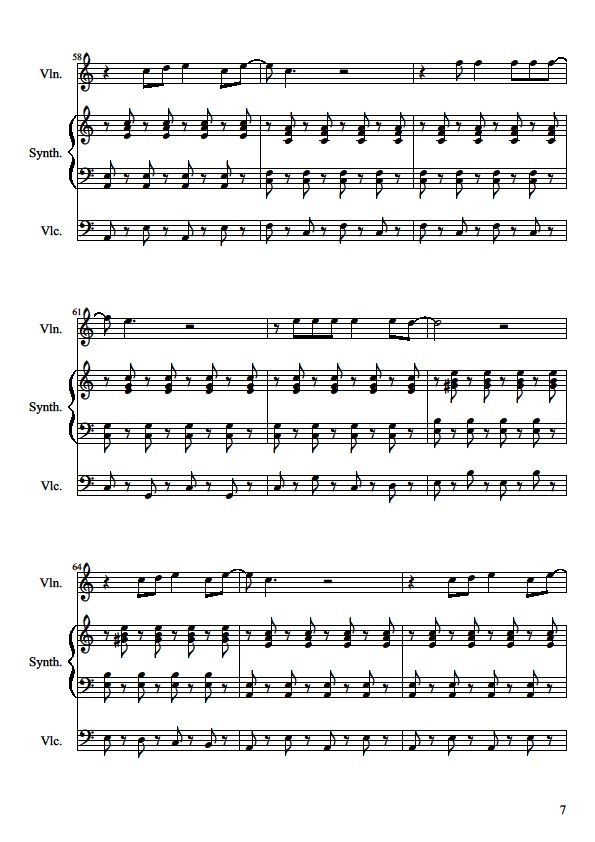
What observations can be made after understanding the musical skeleton of La Bolsa? It is a cuarteto piece with a distinct rock feel. As in a lot of the best songs, the backbone of the song is simple – a four chord progression (Am – F – C – E) which is repeated throughout the piece, albeit with constant variations. There are a lot of really nice harmonies between the two voices, and great solos by the accordion and the guitar at the end. The main melody from the intro is the greatest recognition factor however.
There is not much to be said about the lyrics – I am by now convinced that they are about a tour Bersuit did with “La Mona Jiménez” and one of the members of that band stealing Bersuit’s cocaine bag – we’ve all been there. I love how the lyrics periodically stray from this topic with sentences that are not easily understandable in the context of this interpretation, but which create a colloquial register causing an eagerness in the listener to understand what the story that is obviously being told, is about. Fuertes aplausos!
…si te quedan agallas: Ricardo Arjona… I have been listening to his music for ten odd years, own six of his albums, saw him live once, and even wrote an essay about him in one of my postgraduate courses. Yet, I have to admit that I have a unique love-hate relationship with his music. At times I have been taken aback at how unbelievably abysmal some of his songs are: Recycled melodies and rhymes that were already cheesy the first time he used them (no more luz/blues, please!) and some extremely awkward arrangements where the music seems composed around the most pedestrian poetry.
But I am not here to bash him. Because, on the other hand, he keeps surprising me with things all kinds of amazing; amazing poetry, amazing melodies and themes, texts that seem easily accessible and only when you look closer you discover there is a different layer of meaning… in short, music that touches something inside and which as a musician you can learn an immense lot from.
Santo Pecado is in my opinion Ricardo Arjona’s best album. One reason is that there is no really weak song on it, no song that seems like a rehash of earlier ideas. To the contrary there are some superb tracks, including but not limited to No sirve de nada, La nena, Mujer de lujo and the present track. But maybe most important are the arrangements; as I understand it Ricardo Arjona writes his song on the guitar, or maybe sometimes the piano, so what he ends up with are his lyrics and the sung melody, plus a harmonic skeleton and maybe sometimes a riff. I don’t know in how far it is him who decided that Mujer de lujo was going to be a tango, for example. It doesn’t really matter either. My point is that on this album it fits together perfectly; the genre of a song with its theme, in other words, the musical realization of a song’s content. So many of the songs on this album are really good tracks that could stand alone even with much weaker lyrics. A problem on some of the albums is one of musical economy: While Arjona has of course all the resources he could wish for, to me it seems ridiculous to have a whole string section on a song when all they do is add a cheesy flourish here and there. Such a sumptuous ensemble is only justified when it adds something fundamental to the song in terms of mood or harmony; otherwise it constitutes a poor aesthetical/artistic choice, like a dish with little nutrients and way too much MSG. Santo Pecado features great musical economy.
The present song is representative of the album’s balanced sound: I count the constituents of a classic rock band (acoustic guitar, bass, drums) plus a string section consisting of around one violin, viola and violoncello each, some backing vocals and an occasional synthesizer chord. The song features a classic structure of two verses, pre-chorus, chorus, verse, pre-chorus, chorus and a musically different bridge leading to a short acoustic outro that is usually omitted in live performances. Yet, throughout the repeated parts – the verses, pre-chorus and chorus – there are some subtle changes in the musical texture, creating contrasts and keeping the piece musically interesting. The most obvious example is beginning of the second verse (“Como duele gastar…”) in which only the string section accompanies, but also the second pre-chorus (“El ministerio del tiempo…”) during which the string section rests. Two more things related to the musical realization deserve mention: First, before I transcribed this song I had never realized that the characteristic guitar chord arpeggio that opens the song is actually maintained in some form throughout the whole song, making it a plausible musical representation of the minutes that keep ticking away; except, that is, during the beginning of the second verse which creates a sense of pausing for a moment that coincides with the meaning of the lyrics (“How painful it is to spend the moment in which you are no longer there, what a drain it is to struggle with the things that don’t come back…”). The second thing is Vinnie Colaiuta’s superb drumming that deserves a mention of its own – as on the whole rest of the album his excellent choices of grooves, accents and his awesome fills add something substantial to the songs as a whole; just listen to the part “Minutos pasajeros de un tren…” and you will know what I mean.
I had never really paid particular attention to this song’s lyrics, but as I listened to it again and again while I transcribed, I must say I was moved. The ambivalence of time… who has not wanted the time to pass slower at times and faster at others? Yet, no matter what you do, how you spend your time, the minutes keep ticking away… mercilessly. Once again, if you make an effort to look beyond the sometimes slightly silly expressions you will find that the song is telling a rather moving story that almost anyone can relate at some level. Lyrics-wise, again, I want to turn the attention to specific parts: The part “… si te quedan agallas” (“It’s already 7:16/ and the corpse of the minute that just passed/ tells me your strategy has ruined you/ so there is no choice, but to live alone/… if you have agallas left”). I remember asking my Paraguayan host brother Raúl what “agallas” meant and after short consideration he answered that it meant the same as “ganas” (something like “desire/wish/feeling like doing something”). The Real Academia on the other hand defines it as “Arrestos, valentía, audacia.” (“determination, courage, audacity”) which is close enough to what Raúl suggested, and which I had already intuited. Yet, my point is that I have always loved the illogicality of the phrase: If you have no choice, then why do you need determination? Is it the option to live alone that requires determination? But since there is no other option, why? Or does the option to live alone require courage, so as not to kill yourself? I am not really looking for an answer though – in a way the text is perfectly logical, through its illogicality: “You have no choice but to live alone, and good luck with it” is the slightly harsh meaning I get out of it.
Finally the last part of the song’s lyrics – the bridge: “Minutes that make fun of me/minutes like the fury of the sea/minutes, passengers on a train that is not going anywhere/minutes like a rain of salt/minutes like fire on the skin/minutes, strangers that come and go without letting you know/minutes that hurt when spent without you/minutes that don’t pay rent/minutes which upon dying form the battalion of yesterday/minutes that steal the light away/minutes the corrode my faith/minutes that inhabit the time for as long as they may last/minutes that enjoy dying/minutes that have no place/minutes that crash into me… they are God’s own kamikazes.” Just in case you were wondering why I like Arjona’s music so much.
estás en mi lista de promesas a olvidar: On a car ride in the summer of 2013, I mentioned working on this song to my Spanish ex sister-in-law, asking her whether she knew it. She wasn’t sure about this particular song, but remembered the band as one from her teenage years, “from that age when you suffer a lot, and nobody in the world understands you”. This surprised me in two ways: First, that she knew the band but not the song, since I had always somehow assumed that it was the their greatest hit (maybe from seeing it referenced on an online Latin rock forum). Second, I was surprised about the way she situated the band: I came across this song on internet radio, never heard many of their other songs, and so I did not have any reference, other than the music itself, as to what kind of band this was. Yet after watching the music video and listening to the lyrics more closely, I do understand where she comes from.
There are a handful of bands whose every song I know exactly because they were among my favorites at some point, but I also arrange and play songs by bands which I then only start to learn about as I practise: this is one of them. I cannot recall the title of a single other Héroes del Silencio track. Yet, this song popped up on the internet radio, presumably a Pandora station with a few Los Fabulosos Cadillacs tracks on the list, somehow caught my attention soon and became a favorite. It must have been the chorus that hooked me, and despite the many times I have listened to the song while transcribing it, it still is the chorus that gets me.
The song starts with an acoustic riff accompanied by what seem to be a subdued tabla beat and an occasional sitar strum, possibly a guitar with a sitar effect (the complete version has a short intro with the same “sitar” sound), adding a slight “Indian” flavor; this continues the tradition of hard rock bands who with disarming ingenuity appropriated something ethnic, long before questions of authenticity came into play. (Hint: The musical traditions of India do in fact not sound much like Héroes del Silencio at all). The rest of the band enters during the first chorus, at this point still without vocals, and afterwards verse and chorus repeat until the end, interspersed with a musically different interlude and outro. After transcribing the whole song, arranging it for piano did not pose any major difficulties except for the tabla beat. Especially during the intro and the first verse, the tabla is the only addition to the musical texture besides the guitar riff. Since there is no way of playing a tabla beat on the piano, I determined that, in my impression, what the beat mainly did was add accents on every second and fourth beat, and I decided to include these accents in the form of bass notes in the first and third verse (the tabla beat seems to rest during the second verse).
What is the deal with the chorus and its lyrics? The lyrics to most of the song can be said to be an effort at evocative imagery, or at least that is the way they seem to be intended. In fact, for most of the lyrics I could not say that knowing them has improved my experience of this song. While the images are evocative, they are not developed enough, but rather too disjointed and superficially dramatic to have any serious emotional impact. “In a coffin I preserve your touch, together with a crown of your shaggy hair, wanting to find an infinite rainbow” seems like gibberish somewhere at the intersection of where hippie meets goth. Although Héroes del Silencio fans won’t like me saying this, having Enrique Bunbury’s trademark but undeniably affected voice sing these particular lines does not exactly make it more convincing either. Fortunately, as the song continues, there are fragments here and there which seem much more heartfelt and authentic, first and foremost the chorus; although “I cannot distinguish between kisses and roots” seems like more of the previous hippie nonsense, the rest of the chorus comes closer to a stroke of genius: “I cannot distinguish the complicated from the simple/And now you are on my list of promises to forget/Anything bursts into flames when the proper spark is applied to it.” Now we are talking about something that speaks to the universal experience of the human condition. While a “list of promises to forget” seems pedantic, it is here used as a powerful image that gets across the intended meaning of “suffering because of the inability to forget a sentimental interest”. The connection to the following line is not entirely unambiguous, but it seems to relate to the speaker; unlikely though it may have seemed, it is him who has burst into flames, such was the nature of the spark that was applied to him. Funny as these lines might sound to some, especially when translated into English, they actually amount to a heartbreaking story as old as mankind; it is no accident that this story is sung over and over again since time immemorial.
Another musical highlight of the song coincides with what appears to me as the single most irritating and vaguely disgusting line of the song; I can’t seem to think of a context in which “white sperm running down the spinal column” would not be undesirable and out of place. However, in another stroke of genius, the line coincides with a subtle change of the bass note (replacing the root note with the third) that creates a downward stepwise motion, and in this particular place has an inexplicably powerful effect. In my experience, the resulting dramatic urgency strangely redeems the oddness of the line, as if endowing it with the notion of a deeper meaning that remains inaccessible to me; a truly unique effect of the combination of words/melody with the harmonic skeleton.
Ultimately, it is the video that most expressly proves correct the somewhat flippant statement from above, in that it has hippie written all over it, what with the Jim Morrison moves etc. Is that a problem? It technically isn’t, except for the fact that things hippie slightly bother me; in spite of a range of achievements and influence on the development of public thought and mores that the first hippie generation has to be given credit for, at this time and from where I stand, I have come to associate hippies with an irritating ingenuity (for their clear concept of the enemy), an amount of leisure reserved to upper class kids, and a degree of dogmatism that I am suspicious of in any context. Héroes del Silencio hardly belong to the first generation of hippie thought; still a good song.