Mittwoch, 23. Januar 2013
At The Drive-In - One Armed Scissor
is this the comfort of being afraid: Much of what I have written in my previous analysis of At The Drive-In’s “Non-Zero Possibility” (they do like hyphens, don’t they) applies actually even more to this song, what with the disharmonious chords and awesome guitar lines – I am especially thinking of the “Banked on/Memory” part. This song, certainly their biggest hit, was the first song I heard and learned to love by At The Drive-In and it was the chorus that hooked me up in the first place. The song actually displays a curious structure: Aside from the chorus there is little that objectively connects the parts. We have what we can call three verses between the chorus parts, but they show no resemblance whatsoever, neither musically nor in terms of the sung phrase lengths. The first verse is in ¾ unlike the rest of the song; the lyrics here are spoken rather then sung. The second verse contains what is arguably the most awesome guitar riff of the song and proceeds with increasing entropy on Omar’s guitar, over a descending chord progression by Jim that repeats over and over. The final verse then brings us a stumbling drum pattern with an extended descending melody running in octaves, played by Jim, complemented by a repeating riff played by Omar that at four bars is only half the length of what Jim plays; during the later half of the melody this creates some interesting dissonances and illustrates my point from the other analysis mentioned above, showing how At The Drive-In combine different melodies/ licks in unusual ways creating new “Gestalts” that are as a whole bigger than the sum of its parts. This is also certainly the most difficult part of my arrangement as I have tried to have the running eights in the bass played by the left hand, the melody in octaves in the right, and Omar’s part divided between both hands. In a way, this song barely provides an angle of analysis: The lyrics to me certainly seem like what you could call a collage, juxtaposing loosely related ideas and words that seem to be used for their immediate “color”, that is their effect, sound and association, rather than in a strictly semantic sense: It is hard to claim a literal meaning in phrases like “hallow vacuum, check the oxygen tanks”. This is of course not to say that the song is meaningless or that it does not have a theme; I think of the theme of this song as being a vague reference to alienation and distance, probably with a generous helping of drugs – very much a tale of alienation if you will. The title brings the first moment of confusion: Wouldn’t a one-armed scissor defeat the purpose and thereby defy the very definition of what it means to be a scissor? How is a one-armed scissor not a knife? Are we talking about a knife? I read on the internet that At The Drive-In say a One-Armed Scissor is a cocktail of Red Bull with Vodka, but I don’t see it bringing us any closer to the song’s meaning and I think it’s intended just like those movies with an open ending, where the artfulness actually consists in the fact that it is open for you to interpret. With all this said, I still think drugs are probably a good guess; if we think about At The Drive-In’s heavy drug abuse it would seem hard to believe that drugs wouldn’t at some point invade every aspect of their lives. On a musical level, however, another observation is in order: If you ever saw a live performance by At The Drive-In, you may get the erroneous idea that they are high on coke, banging out whatever sounds their guitars can create and that half of what they do is chaos: While transcribing this song I found the version played on Later with Jools Holland where Omar has thrown away his guitar during the latter half of the song effectively not playing for the last chorus and the end of the song! So while you may be right about the coke part, transcribing this song has made me realize again that what sounds so chaotic live must actually have been put together very carefully: There is an incredible lot of immensely ingenious musical ideas and details hidden – from how Omar’s awesome riff blends with the rest of the band to the last verse with its intermingling guitar voices. So while I agree that At The Drive-In’s music is in good part about the energy and just rocking out, I hope that with this arrangement I have been able to sort of strip away some of the loudness, distortion and chaos, and put a spotlight on the musical skeleton behind it.
Tool - Schism
watch the temple topple over: Much has been talked about this song’s technicalities and indeed I never stopped to find out about its lyrics until I decided to make this arrangement. I am not a progressive metal expert, but what I like about Tool in particular is how they make use of musical sophistication to support their statement, creating musical symbols which at times say so much more than mere words possibly could. Different interpretations have been attached to the lyrics from referencing the need for communication between different religions – the schism in question would be a quite literal one in that case – to what lyrics and video seem to imply in a more immediate fashion: Relationship problems. While everybody is of course free to apply whichever interpretation they prefer, I would like to interpret it in the latter way; it turns out that this might actually be one of the most intelligent, immediately provable songs about relationship problems ever written. The basic idea, then, is laid out quickly: A couple’s relationship is not what it used to be, due to the fundamental differing between the sexes. They say differences attract each other which may be all the more true when mechanisms of evolution come into play: The more different the genes of two persons, the more resistant will the children they engender be, in their fertile days of the month women tend to be attracted to rather masculine men that they might in other moments find impossible to stand etc. It turns out that that difference can be “a light that fuels the fire” at first, but “burns a hole” between the couple once the first infatuation has passed. The pieces “fall away”, although there is a definite belief that “they fit” and can be “brought together”; after all men and women need and cannot be without the other – an insight so obvious that you would have to ask how the human species could have survived otherwise. What has been proven, too, is that male and female communication differ from each other – it is telling that in the video the male character does not have a mouth while the female does not have ears. The only way to overcome misunderstandings seems to be to communicate more, in order to make sure that what has been said is what has been understood etc. Lack of communication, likewise, leads to a cold silence that creates an atmosphere of alienation, disconnection and callousness; the fact that the people in this situation are supposed to be lovers makes it all the more absurd. I vaguely recollect a myth from some part of the world, which advocates the “hermaphroditic primordial shape” of the human being: Man and woman are one before they are born, are separated at birth and spend all of their lives looking for their lost halves. The song reflects some of this: In the end of the video, the two characters reach out for each other, presumably having overcome their communication problems although not without what seems a fit of rage, and consequently blend into each other, becoming one again. “Schism” refers to the separation of a whole, pieces of the same thing that belong together; the hermaphroditic being from the video could be a symbol for a bond like matrimonial union then that turns two people into a unit. Let’s talk about the music: The main riff is composed of a 5/8 and a 7/8 bar each, odd time signatures which sum up to 12/8 which is a regular meter again; an example of how the split or schism is symbolized musically. The verse starting from “The light that fueled…” is quite notable too: The guitar plays the bass riff here, but a fifth above, creating a rather neutral accompaniment. However the vocals are at the same time doubled by a second voice which runs in thirds: Closer analysis reveals that between the guitar and the second voice, both fitting the part they accompany, dissonances as severe as a minor second actually occur. I like to think of this as the couple talking to each other, their intentions perfectly in tune with what each of them they says himself, but somewhere these “unspoken overtones” without anybody noticing have drifted apart from each other and clash. And yes, polyrhythm occurs: For example in “Pure intention juxtaposed…” where 12/8 in the vocals runs against the main riff in the other instruments. The main example however is the bridge at 3:14: The guitar part in 7/8 runs against 7/4 in bass and drums, with a displacement, however, of one quarter note – arguably the most complicated part of the song and it took me a few listens to figure it out. So remember – it is only communicating that the pieces can be brought together again.
Dienstag, 29. März 2011
Thom Yorke - Cymbal Rush


try to build a wall that is high enough: Unlike many Thom Yorke/Radiohead songs, where several meanings and emotions can be read into the song, I believe that is one of the most inherently depressive and angsty songs Thom Yorke has made. It is literally unthinkable for me that somebody might see room for any sort of optimism or relief in this. The hectic electronic beat creates a deeply unsettling background on top of which the billowing synthesizer chords with their disharmonious overlaps unfold a particular disturbing power; it is obvious that something utterly traumatic is being recounted. Personally, I think that the song has lost some of its power in the live version that Thom Yorke plays, for example in the Henry Rollins Show, giving place to something closer to resignation and melancholia; therefore I saw it as a special challenge to try to capture the relentless pulsing of the original version and adapt it to the possibilities of the piano.
The song’s lyrics leave room for a wide range of interpretations – in some forums I have read people attaching meanings from natural disasters such as tsunamis/hurricanes or floods/climate change to war. I particularly liked a comment stating that this was about the end of the world – the song takes on a truly global dimension then, as the end of the world would be something that concerns every single last human being on the planet. However, the line “you should a took me out when you had the chance” clearly signals that whatever the happening, it is to some degree the fault of human beings, at least insofar that they did not act to take out the pending danger that could have been avoided. From what I know about the Third Reich, the lyrics could incidentally be read as a take on the Holocaust (or any instance of genocide) particularly well, too: Many signs of what the Nazis were planning could be noted from early on during their reign, so people started emigrating, warning others to do the same; others who, however, would not “get off the rug”, who tried “to build a wall that is high enough”, ignored the hints of disaster and eventually perished. SA stormtroopers and the SS customarily destroyed Jewish shops and synagogues – especially during the “Kristallnacht”, while the owners would have tried “to save their house”. “Saving their songs” can be interpreted quite literally too, or with the songs representing cultural identity, as much of the Jewish folk song repertoire was lost during the time of the Nazi reign, and only some of it has been recovered by researchers in areas to where Jews had emigrated. The line “try to run, but it follows you up a hill” takes on a particularly gruesome dimension when we think of all the Jews who “tried to run” to Germany’s neighbouring countries, only to be “followed up a hill” when these countries where later invaded by the “Wehrmacht” and further deportations took place. “Ten in a bed” could then refer to either the inhuman conditions in the concentration camps or to accounts of Jews who were hiding in secret cellars and attics; as the line is taken from a children’s song the contrasting new context accounts for an especially shocking juxtaposition. There are many stories of Arians who would not help Jewish people who had been their friends before; these could be the “losers who turned away”. Clearly, the Holocaust as a nightmarish scenario of industrialized mass murder would explain how there can be no room for hope in this song. At the same time I believe that the song’s lyrics are intended to leave room for any kind of interpretation; anybody who has ever written a song before might know how the musician many times starts out with a mood that he seeks to express rather than a definite and clear picture. What is clear though, is that the song deals with some kind of traumatic experience; scientific research has shown that normal experiences are categorized and thereby quasi “filed/made sense of” when stored by our memory, whereas traumatic experience can never be processed in that way and return always with the same intensity and realness as when it was first experienced. Thus, traumatic memories can never belong to the past, but always belong to the present. And clearly, witnessing terrible things happening to “our loved ones” is the one thing in the world that exceeds the sum of all harm that can be inflicted on us ourselves.
At The Drive-In - Non Zero Possibility


this hex was delivered spent: When I first started listening to At The Drive-In five years ago, I liked them because I thought the vocal style was similar to the one of Rage Against The Machine’s Zack de la Rocha: This was like Rage Against The Machine with a melody! I bought Relationship Of Command and it was only after some time that I started to discover the many layers within the songs and the unique aesthetics of At The Drive-In’s songwriting; there was something always a bit “off” about the melodies and riffs, making them sound at the same time familiar, but with a certain edge to it that I had never heard in any other band. Only much later when I started playing some of their stuff on guitar, I discovered what I believe to be the reason for this; at first I thought of At The Drive-In as the “neoclassicists” of rock music, as we had recently learned in school about neoclassicism in classical music. One of the principles to be found for example in P. Hindemith’s music was the so-called “emancipation of the interval”, meaning that an interval could now be a characteristic feature that was elaborated on, largely unfettered by harmonic limitations. Thus you find a characteristic motive that seems familiar itself, but is contrasted and combined with other melodic lines in ways that appear unusual to our ears. A successful concept indeed that can be applied to many areas: recently I went to a rather successful modern-style Korean restaurant and I found the grilled meat to be just familiar enough to be easily enjoyable, yet some other ingredients gave it the certain edge that turned it into something special. At The Drive-In’s music is similar: In songs like Pattern Against User or One-Armed Scissor we hear guitar licks that are very close to what we are used to while contrasting them with chords that you will not find in any guitar book, using lots of open strings or handy fingerings. The result is what I like to call the “Gestalt effect” of music. I am not an expert on Gestalt psychology, but just to get an idea take a look at the picture.

You will probably see a white triangle, even though the visual information consists only of three incomplete circles: Due to its organizing qualities, our brain tends to structure information into patterns that make sense, deliberately completing the picture into something familiar. The phenomenon is sometimes referred to as “a whole being greater than the sum of its parts”. Again, very true concerning the music of At The Drive-In. When I first started playing it on guitar I was rather disappointed by the “parts”: What I played sounded disharmonious and not nearly as awesome as the riff that blasted from the speakers. Were the tabs wrong? No, this was definitely the way of playing it, I could tell that. So it turns out that many of At The Drive-In’s awesome melodies, riffs, licks etc. are a “great whole”. This is not unusual in every kind of music of course, as a combination of voices almost universally creates a richer texture. What is special about At The Drive-In then, is that much of their music sounds totally DIFFERENT when one part is played alone or just at a different speed than usual. So in the first place, the music creates a new “Gestalt effect” as soon as it reaches a certain tempo which is pretty amazing and not at all common in rock music; I can think of an example in classical music though – if you listen to G. Gould’s performance (very slow) of the first movement of Beethoven’s Appassionata Sonata and compare it to any other performance of that piece, you will know what I mean. Yet, this is not where At The Drive-In’s awesomeness ends. I have repeatedly noticed that my brain tricked my into believing I was hearing certain melodic shapes in At The Drive-In’s songs, only to find on a closer listening that they were absolutely NOT THERE. For example, I always perceived the melodic contour of the phrase “This hex was delivered spent” as being arched, until I transcribed the song and realized that the melody was rather moving back and forth between two notes. Now what is so awesome about all this is that while I may understand how a Gestalt effect can take place in music I find it hard to imagine how you can possibly put it there on purpose. And there are so many examples that it rules out a mere coincidence. So even though I mostly listen to music other than rock nowadays, this is why At The Drive-In will always be up there among my top five favorite rock bands.
Freitag, 28. Januar 2011
Thom Yorke - Analyse


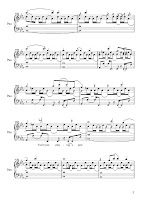
you’re just playing a part: This gem of hopelessness has been with me for about 4 years now; around the same period of time that I have been playing piano – incidentally this was one of the first songs I tried to play. Even though Thom Yorke’s live version has a hypnotic intensity of its own, I always especially liked the feel of the studio version’s hectic drum beat, the interplay of the different melodic lines and the uneasily simmering background soundscapes. So I decided to take the challenge to fit as much as possible of the studio version into a piano arrangement – this is the most comprehensive that I could.
In this song five different “sonic instances” can be heard apart from the voice. The song starts out with vocals, a characteristic, somehow “waving” shifting two-note pattern in off-beat (continuing throughout the song) and a melodic line which mirrors that of the vocals, both of these played in a piano-like timbre, the first with an echo effect. The bass guitar adds the root tones, but takes on a rather subdued role in terms of rhythm, whereas the synthesized drums account for most of the rhythmical characteristics of the song, featuring a fast-paced pattern throughout the song with only slight variations, mostly in the bass drum accentuations. Altogether this creates a thick texture of interwoven melodic elements; interpreting the song as a statement on modern-life purposelessness we can safely say that the merciless drumbeat accents underline the concepts of monotony and the elapsing time of people, stuck in a pattern of daily routine, while the intertwined texture may symbolize the complexity of modern life and the many choices we have to make among the millions of possible options. As becomes evident, the music does not serve simply as a vehicle that carries the lyrics, but expresses much of what is mentioned in the lyrics on a different and much more immediate level. During the first refrain (“It gets you down…” – 0:38), the whole texture is quasi immerged in a synthesizer chord – I like to think of it as a “sound plain”. At 1:17 into the song the piano line mirroring the vocal melody drops out, whereupon the drums rest for the only time throughout the song (1:36). Fittingly, this coincides with the line “there is no time to analyse, to think things through, to make sense” – it is as if the individual had finally stopped to think things through for a moment, and even the bass guitar gives some breathing space by skipping its usual dotted beat. However, there is no time for this, so starting with the drums the whole apparatus kicks in again after just for bars; the sound plain - while subdued at first/dropping out during the last passage – returns with renewed intensity. The bass soon gets more aggressive too (1:55) taking big leaps in a syncopated rhythm. Another “instrument” enters – high-pitched synthesized notes of a drop-like intensity that I will call “treble drops”. After another lull period (3:02) which reflects utter resignation, all instrument join in as hysteric as ever, only to fade out suddenly and disharmoniously shortly later.
My arrangement seeks to represent all the details relevant to the thematic unfolding of the song: The left hand plays the parts of the bass, but includes the accents in the drum beat. The right hand meanwhile plays the two-different piano patterns – some of the additional harmonies that the sound plains, which could not be considered further, add, are included on non-accentuated times in the left hand. As the treble drops enter, the arrangement shifts into a higher register with the bass reduced to a sustained root note at times.
There is no time to analyse, to make sense. What if there was? Would it do any good? I have had plenty of time to analyse, basically it is most of what I have been doing in my life, but I am growing ever more uncertain it has added anything valuable to my life, save avoiding some of the commonplace cognitive pitfalls. Yet I realized that it has also withered my intuition and separated my body from the mind. That is why recently I have preferred sticking to doing rather than thinking or talking and I fare rather well with it.
Abonnieren
Posts (Atom)


